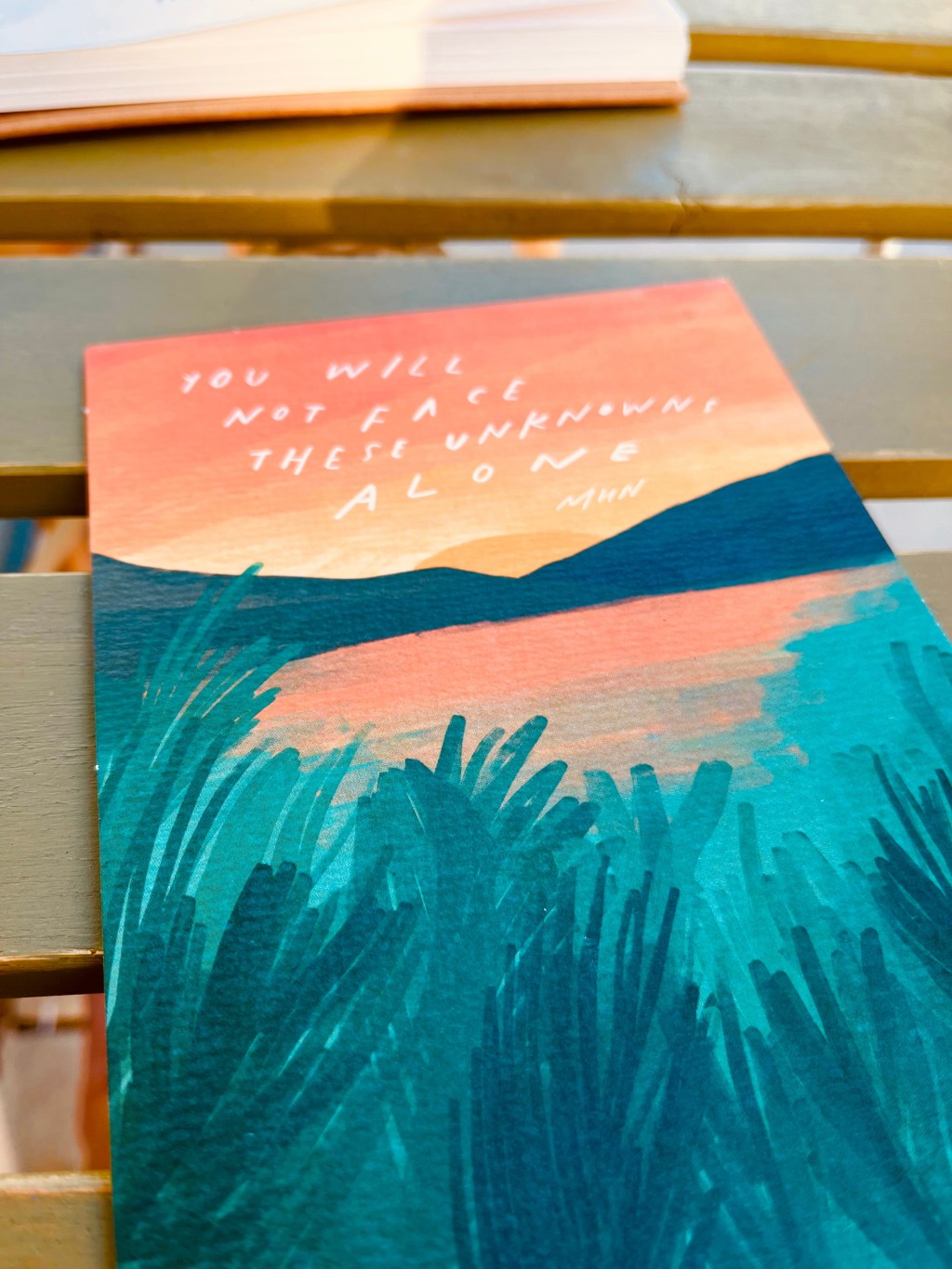
Sometimes I tell myself awful stories.
I am in my thirties with a license in clinical social work, but I have no job, and a few hundred dollars in my bank account. I live with my mother in the town I grew up in, a place I never wanted to return to. I’m completely dependent on her for a roof over my head, and can only afford therapy thanks to generous friends and family. Most days I do what feels like a whole lot of nothing, trying to find reasons to get up.
I feel like a failure of an adult.
And I fell from a high place. Six years ago, I was a valued clinical director working sixty plus hour work weeks and collaborating on decolonized approaches to mental health. I was a deeply loved and involved part of my church community after years of working with families, mentoring youth and guiding conversations in reconciliation work. I had the most lovely, compassionate group of close friends who would do anything for each other and had done so for a decade. I owned a home that settled my nervous system, an aesthetic that gave me an immediate deep breath and a gear shed full of items that equipped all types of adventures outdoors. I had financial security and the chance to practice buying myself more than just a cup of coffee for self care. I had a partner I deeply loved and shared every joy, every sorrow, every mundane moment and future dream with.
And then, piece by piece, it all fell apart.
It started when I made a choice about my body for myself. I chose to be sexually intimate with my partner before marriage, and was asked to leave my position as a youth leader at my church. My close friends could see that I was hurt, but aligned with the sentiment that it was my fault. Walls I had allowed to come down in the presence of this community came right back up, and I found myself wanting more and more distance not just from them but from all people.
That same year I caught a severe viral infection while traveling in Peru, and never recovered. I became increasingly sick with debilitating fatigue, systemic inflammation, migraines and joint pain, recurrent yeast infections and UTI symptoms, neuropathy, memory impairment and chronic diarrhea. Three years later, I was diagnosed with Chronic Lyme Disease. Lyme rarely travels alone; turned out I also had Chronic Epstein Barr Virus, mitochondrial deficiencies, POTS, a mold infection, SIBO, Raynaud’s Syndrome and an autoimmune disease called Pernicious Anemia. I worked for a year and a half like this, and quit when I could barely get out of bed.
My body was breaking down under the weight of disease and emotional pain I didn’t understand. My partner cared for me in both realms with more kindness, devotion and sacrifice than any human can sustain. I moved further and further into isolation, wrapping my pain in armor and moving with my partner to Hawaii so there was an ocean between myself and everyone I knew.
There was so much I did not understand about my reactions, particularly the magnitude of them. I did not understand why I felt like I was suffocating in the life I had built. The story I told myself at this time: I’m overreacting, making a big deal out of nothing. I shamed myself for the amount of rest I desperately wanted, the immensity of distance I chose, and the degree of collapse I was always on the verge of.
One of the things I understood the least was my relationship to sexuality. As soon as my partner and I got married, I shut down sexually. I didn’t want to be touched. I didn’t want to have sex, talk about sex, think about sex, or go anywhere near sex. We spent four years like this, despite him being my safest place and favorite person. Four years of “What the fuck is wrong with me?’”
I wanted more for me, and more for him. I wanted to know if this part of me could come alive again, and I wanted him to have someone who wanted to connect with him in this way. So when we moved to Hawaii, I made a decision I had resisted for a long time and asked to divorce. It caused him so much pain, even as he understood and supported me. I knew there was more wholeness for us both in life, and I didn’t know any other way to get there.
Something about that choice restored an agency over my body and myself I hadn’t known. Sexuality came back online, and the desire was pointed in my partner’s direction. We attempted an open relationship as a way of staying connected while giving us both agency over getting to know our own sexuality as ours, not something we owed someone else. It was a valiant effort at selfless love, but too painful. I think we both had attachment wounds that ran deeper than we knew. After a year of this, my partner asked to separate. This is easily the most catastrophic blow I’ve ever had to my nervous system, and the grief that followed the deepest I’ve ever drowned in. I moved home with my mother, and a year later got the call that he was moving on. He had carried too much for too long, and never fully recovered from when I left.
In the midst of this, my parents announced their divorce. I am and will always be so proud of my mother for this, for choosing that she still had life to live and deserved better than being victim to severe narcissistic abuse from my father. And, the losses kept mounting. My brother blamed me for it, and our already deteriorating relationship turned into estrangement. My father would no longer be an automatic part of my life, and with the safety of separation my memories surfaced. What had only to this point been recurring nightmares, flashbacks, hypervigilance and shut down finally had the explanation that explicit memory gives: my father abused me sexually, starting at age seven.
There is only so much a body can take. There is only so much a soul can take. And this was my breaking point.
And so, here I am. At the bottom of having lost my church community, my closest friends, my health and energy, my job and financial security, my brother, my direction, my home and familiar rhythms, and the person I love most in the world. I had over-functioned for years, and my pain was no longer buried but at the surface. I began to feel it all, without the person who felt like home, and I could not function. We use big words like compounded grief and complex, developmental trauma, but what feels more accurate is my heart broke. The way a leg breaks and you can’t use it anymore. It was muscle failure: severe overexertion that leaves you unable to produce a single contraction more.
As I write this now, I have more understanding about my pain. It is easier to see that I am hurt and need to heal, need to be non-load bearing for a while. That I am processing childhood sexual abuse, emotional parentification, twenty-five years of religious trauma, chronic invalidation and multiple losses in a short amount of time. That those things added up are very heavy, and while I chose some of those losses out of self-protection, others I did not and would not have chosen to endure. Some days I can see this.
But there are a lot of days where the story I tell myself is harsh:
I made a mess of my life.
My partner was right to leave, I’m too broken.
I expect too much and am hard to be in relationship with.
I am an overly sensitive human who can’t seem to function like everyone else.
I’m the common denominator to all of this loss, maybe they’re right that it’s my fault.
I recently shared my shame with a friend. My shame that I “can’t handle” something that a “normal adult” is expected to. Why can’t I just pull myself together and work? Why can’t I just put up with a few more weeks in this apartment? Why do I need to flee to coffee shops day after day? Why couldn’t I have stayed in relationship with them? Why can’t I manage to create a stable life? Why can’t I handle one more small thing? It makes me feel fragile, reactive, irresponsible, weak. Broken.
I am a trauma therapist asking myself the forbidden question: What is wrong with me?
And then I imagine this through another lens: Let’s say someone has just performed 200 deadlifts at 165lbs. If I walk into the gym at this moment, when they can no longer lift a single 5lb weight, they might seem weak. Are they fragile in that moment? I suppose so; they are momentarily in a state of having spent their strength. But are they a fragile human, unable to “function like a normal adult” ? God no. They’ve just performed an incredible feat. They just need to rest. And, that is actually the only appropriate thing to do in that moment.
Maybe there is nothing wrong with me. Maybe these are very appropriate reactions to what I’ve been through, very appropriate protests from my body crying out, Enough. I’m done. I can’t.
I think the best response I can give myself is, You are right to feel that way. To want distance from what hurts you. To want rest from carrying what isn’t yours. To ache to be loved, and allowed to exist with needs. To need practice with safe connection. To want sovereignty over yourself. To crumble under the load you bore. To grieve for a long time when you lose the person who you could rest most with. To feel uncertain where to go from here. That anyone who had gone through what I’ve been through would feel this way.
And so, this is me saying I am going to try to be kinder to myself. I am going to try to tell myself kinder stories. I will try to ask for reminders from those who know me, who see me not as weak but as a “ship that carried myself through the deadliest storm.” I am going to try to see that I am not broken or a failure, but hurt and healing.
I want to unfold.
Nowhere I wish to stay crooked, bent;
for there I would be dishonest, untrue.
I want my conscience to be
true before you;
want to describe myself like a picture I observed
for a long time, one close up,
like a new word I learned and embraced,
like the everday jug,
like my mother’s face,
like a ship that carried me along
through the deadliest storm.
– Rainer Maria Rilke

